One thing about traveling , particularly overseas is the concern should I lose ( have it stolen ) my wallet/Phone, I would not have any easy to recall phone numbers (who types in numbers these days) or credit card info or passport # or anther important information, I likely couldn’t access my e-mail as trying to login from a new computer/smartphone would request a 2FA text to your now stolen/lost phone, so it becomes a major hassle..
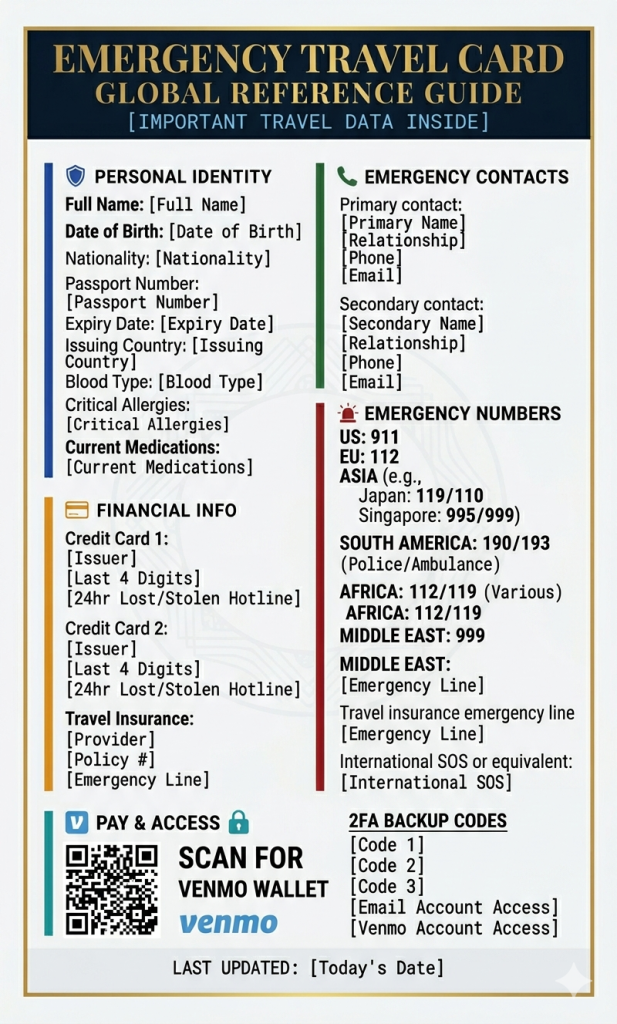
So to help minimize the hassle of getting some information back, I recommend everyone print out an emergency travel card, such as the one below. Print out a smallish version say 5″x3″ or even a 4″x2″ so you could place this card or have multiple cards underneath your shoes sole, along with your luggage tag, or inside lining of a coat jacket or anywhere else that’s separate from your wallet/phone… this way you can retrieve it
Word /google Docx Emergency card Template
Here’s a variation of this template as a Word Docx that can easily be edited and updated in Word or Google Docs
AI Prompt to Create your own card:
Head over to gemini or other AI image generation platform and issue this command., fill in the details for your specific information
Create a single-pageimage emergency travel card for me to carry at all times. The card should be designed to fit on a 3×5 inch (or A6) card when printed, and should work beautifully both on screen and in print.

CONTENT TO INCLUDE (use placeholder brackets like [YOUR NAME] for each field so I can fill them in):

? PERSONAL IDENTITY
   • Full name, date of birth, nationality
   • Passport number, expiry date, issuing country
   • Blood type, critical allergies, current medications

? EMERGENCY CONTACTS
   • Primary contact: [Name], [Relationship], [Phone], [Email]
   • Secondary contact: [Name], [Relationship], [Phone], [Email]
   • Family doctor: [Name], [Clinic], [Phone]

? FINANCIAL INFO
   • Credit card 1: [Issuer], [Last 4 digits], [24hr Lost/Stolen hotline]
   • Credit card 2: [Issuer], [Last 4 digits], [24hr Lost/Stolen hotline]
   • Travel insurance: [Provider], [Policy #], [Emergency line]

? EMERGENCY NUMBERS
   • Local emergency Services for major destinations (Europe,North America, South America, Asia, Africa, India,Middle East)
   • Nearest embassy/consulate: [Address], [Phone]
   • Hotel/accommodation: [Name], [Address], [Phone]
   • Travel insurance emergency line
   • International SOS or equivalent

? TRAVEL DETAILS
   • Destination(s), dates of travel
   • Airline + flight numbers
   • Hotel confirmation number(s)

DESIGN REQUIREMENTS — make this visually exceptional:

• Use 3 distinct, characterful fonts: a bold serif (like Playfair Display or Cormorant Garamond) for the card title, a clean geometric sans-serif (like DM Sans or Outfit) for contact info, and a monospace font (like DM Mono or JetBrains Mono) for codes, numbers, and IDs
• Import fonts from Google Fonts
• Use a sophisticated dark navy header (#0A1628) with gold accent text for the card title, with a thin gold border framing the entire card
• Color-code each section with a distinct, elegant left-border accent stripe: deep red for emergency numbers, royal blue for identity, forest green for contacts, amber for financial info, slate purple for travel details
• Include minimalist SVG icons next to each section heading (a shield for identity, phone for contacts, credit card for financial, siren for emergency, plane for travel)
• Use a two-column grid layout where space allows, with section headers in small-caps
• Add a subtle watermark or pattern in the background (e.g., a very faint passport-stamp style geometric motif)
• Print-optimize with @media print CSS: remove shadows, ensure high contrast, fit exactly to the page
• Make all text large enough to read under stress (minimum 9pt for body, 11pt for critical numbers)
• Add a "LAST UPDATED:" field with today's date at the bottom in monospace
• The overall aesthetic should feel like a luxury hotel key card meets an Interpol document — sophisticated, authoritative, and instantly trustworthy
Other travel tips for emergencies and lost documents
Before You Leave Home
- Photograph every card in your wallet (front and back) and email the images to yourself
- Save copies of your passport, visa, travel insurance, and itinerary to Google Drive or iCloud so they’re accessible from any device
- Write down 3–5 critical phone numbers by hand and keep them in your luggage separately from your phone
- Register with your country’s embassy online before traveling (the US has STEP — Smart Traveler Enrollment Program)
- Tell your bank which countries you’ll be visiting and get their international collect call number
- Set up a secondary email you can access from any browser (not just your phone app)
- Leave a copy of your passport and itinerary with a trusted person at home
- Carry a small amount of cash in a separate hidden location (money belt, inside a shoe)
If You Lose Your Cards
- Call your bank immediately using the number on your emailed photo or the international collect number — most banks can wire emergency cash or issue a temporary card within 24–48 hours
- Contact your travel insurance provider — many policies include emergency cash advances
- Western Union and MoneyGram allow someone at home to wire you funds within minutes, receivable at thousands of locations worldwide
- Ask your hotel front desk for help — they deal with this regularly and often know the fastest local resources
If You Lose Your Phone
- Use any hotel computer, library, or internet café to access your cloud-stored documents
- Log into your Google or Apple account from any browser to access backed-up contacts, maps, and photos
- You can use Google Find Hub (andoird) or Apple’s Find my Phone to help locate your device.
- Use WhatsApp or iMessage via browser/web version to contact family
- Your carrier can usually suspend your line remotely and issue a replacement SIM at a local store or ship one to you
Re-Establishing Your Identity
- Go to your country’s nearest embassy or consulate — this is your single most important first stop
- Bring any secondary ID you have (even an expired one), your hotel booking confirmation, flight records, or anything with your name on it
- Your embassy can issue an Emergency Travel Document (ETD) or a temporary passport, typically within 1–3 business days
- If you have your passport number memorized or photographed in your email, the process is significantly faster
- Ask the embassy about their emergency citizen services line — most operate 24/7 for genuine emergencies
- Local police can issue a theft or loss report, which serves as an official document supporting your identity claim and is often required by the embassy
- Hotels can verify your identity if you checked in with a passport — ask them to write a signed letter on their letterhead confirming your stay and ID they recorded at check-in
General Mindset
- Stay calm — consulates handle this every single day and the process is well-established
- Keep a small card in your luggage (separate from your wallet) with your embassy’s address and phone number written in both English and the local language
- The emergency travel card prompt you just created is exactly the kind of backup that makes all of this dramatically easier